Hey friends! I'm starting a *4 week* blog series entitled "What's the Dill Pickle?" {haha...get it?! Of course you did. You're a teacher. This is the kind of humor you hear on a daily basis from the batch of Laffy Taffy joke-sters that fill your student desks on a daily basis.}
The blog series will focus on some of the *hottest* teacher topics, strategies, and skills in ELAR. As school quickly approaches, I thought it would be a great time to go over some of these skills and strategies that are super important in today's classroom.

The first topic of conversation is close reading.
Close reading is a "hot topic" across the education spectrum and can sometimes be used as a "buzz word" instead of an actual strategy.
Let's just jump right in.

Close reading is reading with intention and purpose. It's a relationship between the reader, the text and the author as the reader gets to know the text.
It is looking closely at a text, digging deeper in meaning and understanding of what the author is saying to the reader. The reader looks for context clues to find what the text structure of the passage is. The reader is also looking for the author's message, opinion and purpose behind the written text.
It is looking closely at a text, digging deeper in meaning and understanding of what the author is saying to the reader. The reader looks for context clues to find what the text structure of the passage is. The reader is also looking for the author's message, opinion and purpose behind the written text.
Let's try it. We can close read anything.
Take a gander at close reading this cereal box. Yes. A cereal box.
Read this with intention.
Look for the connections between the reader {that's YOU} and the author.
Read this with intention.
Look for the connections between the reader {that's YOU} and the author.

If you're like me, you had to zoom waaaayyy in to see that tiny text. But even if you didn't read all the tiny text, what did you find when you paid close attention to the details? What did you find out when you read this box intentionally?
My findings while reading with intention:
- It's made with real honey
- It's more than just Honey Nut Cheerios; it has clusters mixed in
- It has natural almond flavoring
- It can help lower cholesterol
- It had crispy flakes
- It has crunchy almond clusters
- Whole grain is it's #1 ingredient
- The author says it will "make your heart sing" = figurative language; Literal meaning = The author wants the reader to think this cereal will make you happy when you eat it.
- The author's word choice, as well as the bright colors and happy images lead us to believe that his opinion of this product is very high. He believes in the goodness of this cereal because of the positive word choice throughout the front and back of the box; i.e. - healthy, help, enjoy, incredible, sweet sound.
- The author's purpose is to inform the reader of the deliciousness of this cereal, as well as its health benefits. Also, to encourage the reader to try this new cereal by using enticing words.

Close reading helps the reader to connect with the text.
For example, many times, I find myself reading something and my mind trails off to what I'm going to make for dinner, the laundry that needs to be switched over to the dryer, how I'd rather be watching Netflix instead of reading another blog post on close reading and so on and so forth. {Ya catch my drift?}
Think of the babies in your classroom. What do their minds wonder to?
Close reading teaches the student to not only read the words, but to engage with them in the passage. It teaches them to relate to the author and make connections both with the text and themselves.
Remember, you can close read anything.
Let's close read this excerpt from Diary of a Wimpy Kid.
{If you'd like, just print this article out and engage in the text as your read it by annotating}
First, read it for pleasure.
Then, read it for a deeper understanding. See what you find as you read and how you connect.
First, read it for pleasure.
Then, read it for a deeper understanding. See what you find as you read and how you connect.

What did you notice the first time you read this excerpt?
My findings:
- this is a "journal" entry written by a little boy in a diary
- his mom bought the diary
- the entry was written on a Tuesday in September
- he doesn't want to be called a sissy
What did you notice the second time you read this excerpt?
My findings:
- the tone of this passage was serious, with a twinge of annoyance
- the little boy uses sarcasm in his writing
- it reminds me of "Moms" in general; wanting their children to express their feelings
- INFERENCE: maybe the mom bought a "diary" because that's what she used to write her feelings down as a young child
- the illustration connects to the text about a jerk finding him writing in his "diary/journal" and beating him up for it
The first time I read this excerpt, I made general statements about the text that was right there and easy to detect. I didn't infer, draw conclusions, make text connections or identify the author's opinion or writing style. The second time around reading this excerpt, I already knew the basic idea of the text, and I connected and engaged more with the text because of my basic background knowledge. I made inferences based on my own life and my own mom. I noticed the tone and writing style of the author. I connected the illustration with the text.
As a real reader, we are always making connections.
Take Nicholas Sparks for example. His books are full of drama, mush, hope, dreams, romance and tears. These are just a few reasons why women swoon over each of his novels. We connect with them.
I Googled "Nicholas Sparks excerpt". This popped it. {I have no idea what book this is from, but I'm pretty sure it would fit into any and all of them!}

- What connections did you make when you read this with intention?
- What/who did you think about?
- What moments in your marriage, or relationship, did you flashback to?
- Did you agree to disagree with the author's opinion?
- Do you have the same perspective?
Here is a sample of someone's close reading as an adult with another Nicholas Sparks' novel. Clearly, this person connected deeply with this paragraph.

Close reading is critical to comprehension of a text.
If you aren't reading with intention (either for pleasure or as a school assignment), what's the point of reading what you're reading?
An author's purpose is either to:
- explain
- inform
- entertain
- persuade
A reader reads to:
- understand
- enjoy
- form new ideas or beliefs
Close reading teaches the students to talk back to the text.
When I read, I tend to use Post-It notes, underline and highlight as I "talk back" to the text.
Here is how my adult "close reading" looks from a book that I read as part of a study we did with our youth group. {Side Note: this book was fantastic. It's deep, but it's ah-mazing.}
Here is how my adult "close reading" looks from a book that I read as part of a study we did with our youth group. {Side Note: this book was fantastic. It's deep, but it's ah-mazing.}

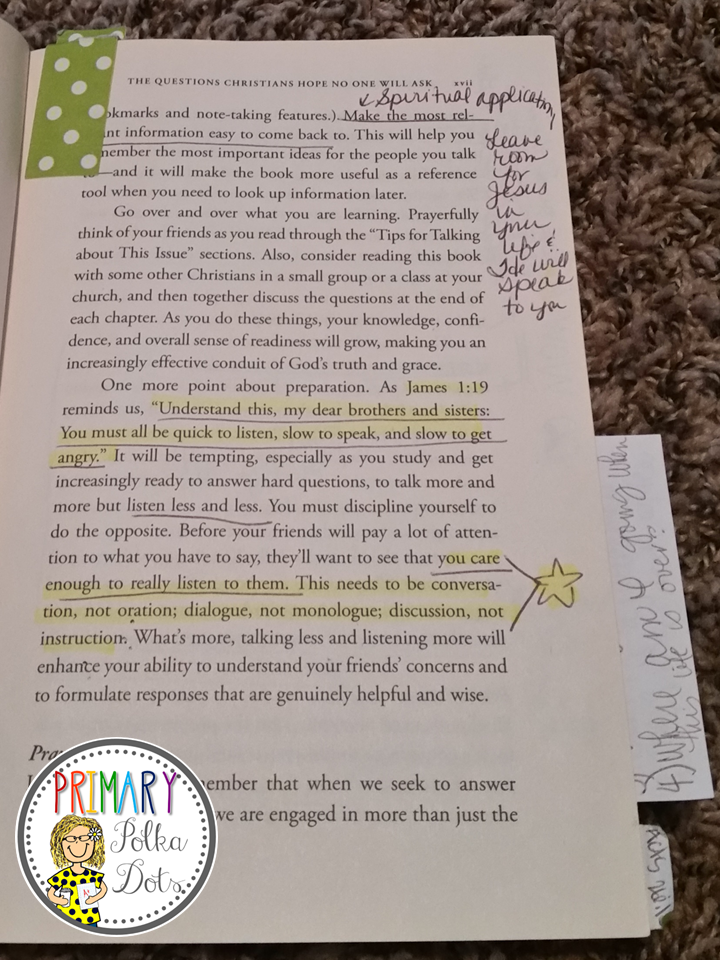

By using Post-It notes, underlining, using little "eyes" and stars, I'm able to talk back to my text and label important information I want to remember later on.
By "chunking" the paragraphs together, it helps me to know that that information will be helpful to me later on.
Highlighting draws closer attention to key details that I want to engage in later if I come back to this passage as a reference while teaching this material to my Bible study girls.
By making little notes in the margin, I can record my thinking and understanding.

Teaching students how to close read takes time and practice.
Model, model, model!
From K-2nd grade, students are learning to read.
Then 3rd grade happens. You start reading to learning.
Learning to close read changes the way a student comprehends what they are reading for the rest of their life.
1) Define close reading for your students.
Teach them what this means.
Create an anchor chart that can stay up year round. Before you can teach them how, they must understand what it means and what it looks like.
Explain to your students that close reading is simply real reading by paying close attention to what the text is saying.
Here's a freebie that you can print and copy for your students to put in their reading notebooks or folders. This is a great reference for them:

Here is a sample anchor chart you could use in your class:

This mini-resource pack is also great to introduce close reading to your class. These posters are great to leave up all year long.

2) Be intentional with teaching close reading strategies.
Don't be afraid to randomly one day (even if it's December and the year is half way over) introduce the term "close reading".
Use real, close reading ALL OF THE TIME, not just in reading class or with a worksheet.
On field trips, find signs or displays and close read them together to find what information is key and important.
On the Germ-x bottles, read the labels to understand what Germ-x does and how it works.
In the hallways at school, read the school's mission statement and determine how it applies to them.
On juice boxes at lunch, read the label to determine what's in the juice and why it's important they drink it.
3) Determine together as a class annotations and labels they can use as they "talk back" to their text when they are close reading.
This is important to do.
It helps give them a foundation of where and how to start "talking back" to their text.
Here's a way to do this from my SELFIE: Close Reading Unit {It's a great way to introduce Close Reading gradually. It has great examples of close reading and not just with passages}.

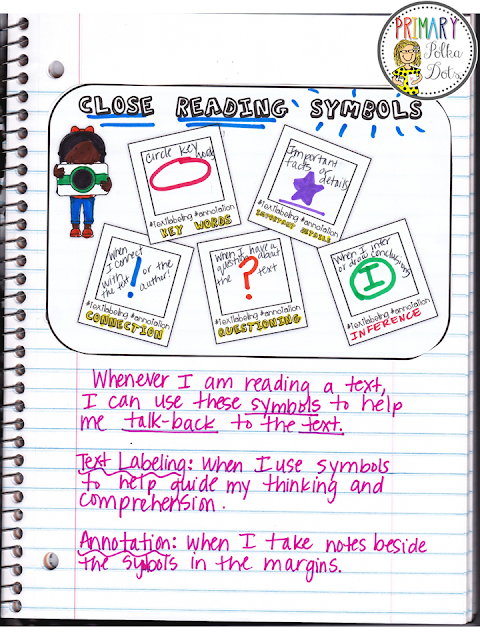

4) Model, model, model!
While reading aloud an excerpt from a book, stop every couple of sentences and share your thoughts on what you have read. Record your thoughts on an anchor chart, or by using Post-It notes.
Blow up a portion of the book onto a poster sized anchor chart. Make notes on the poster showing the students where you would insert your thoughts as you were reading them.
Show them many different samples of close reading with annotations and text labeling.
 |
| http://www.scholastic.com/teachers/sites/default/files/posts/u134/images/19_close_reading_text_3.jpg |
 |
| https://www.teacherspayteachers.com/Product/Close-Reading-Nonfiction-886168 |
 |
| https://plebeianincorporated.wordpress.com/https://plebeianincorporated.wordpress.com/ |
 |
| http://mrsapiasclassroom.com/literacy/close-readings/ |
Bring in a copy of a book you have read on your own for pleasure (or you were voluntold to read for a PD), and show them your Post-it notes, your annotations, your scribbles, your doodles that helped you connect and comprehend with what you were reading.
5) Practice, practice, practice!
During mini-lessons, allow students to practice real, close reading by using excerpts or articles.
In small groups, work with students using chapter books or excerpts or poems, practicing using the strategies you taught them. Allow them to use Post-it notes, highlighters and pencils (if it's their own book).
Teach them to use graphic organizers to close read. They won't always be able to write in the book, but they can organize their ideas on charts or graphics they create.


Remember - not all text labeling and annotating will look the same. Students will make different inferences, have different connections (some will have more than others) and have different questions as they are reading. Some will want to highlight the whole passage, while some will choose only few details to underline.
Close reading is personal and intentional. As I said before, it's the relationship between the reader, the text and the author.
6) Be real!
Real reading only happens if the reader is engaged.
Remind your students that real reading happens all the time, everywhere.
And reading closely takes time and effort.
Any relationship takes time and effort.
The relationship between the reader, the author and text is just as time consuming.
However, the state test doesn't always allow students to hum-drum over a paragraph for an hour.
Practicing close reading strategies throughout the school year will allow your students to pay attention to the key details they need to be honing in on.
It's okay to not always read a text 3 times over. Spend time throughout the school year using the close reading strategies the first read of a text. See what information they can derive from an initial read.
Model, practice! Model, practice! Model, practice!
A great tool for this is my Daily Close Reading paragraphs. They are simple, quick reads that spiral key reading content and skills throughout the year while practicing close reading strategies.
Try out my August Daily Close Reading paragraphs for free:

Here are some other samples from September & November's Daily Close Reading paragraphs;


These are great as morning work, small group work or in a literacy center. Some teachers have told me they send them home as homework, and review them first thing the next day.

Close reading doesn't save the world of all wasted time "pretending to read". However, it does teach your students how to engage and connect with the text and why real reading is so important.
Don't become overwhelmed with the idea of teaching close reading strategies. Go slow, and remember it's not about how many things your students underline and highlight.
It's about your student connecting with the text and comprehending key details, ideas and messages from the author of the text.
Don't get caught up in Post-it notes and highlighters.
Use engaging, fun articles and texts that will have your students *craving* to read to learn on their own!
...AND because you read this article {but you may have skimmed and scanned it because it was soooooooooo long}, I have a giveaway for YOU!
1) Comment on the post 1 thing you learned from this article about close reading.
2) Leave your e-mail address in the post.
3) Share this article either on Facebook, Pinterest or Instagram (tell which in the comment).
4) I'll pick 3 winners to win 2 of my Close Reading Products from my store - YOUR CHOICE of products!
What are some of your favorite books and articles to use when teaching your students how to close read?